
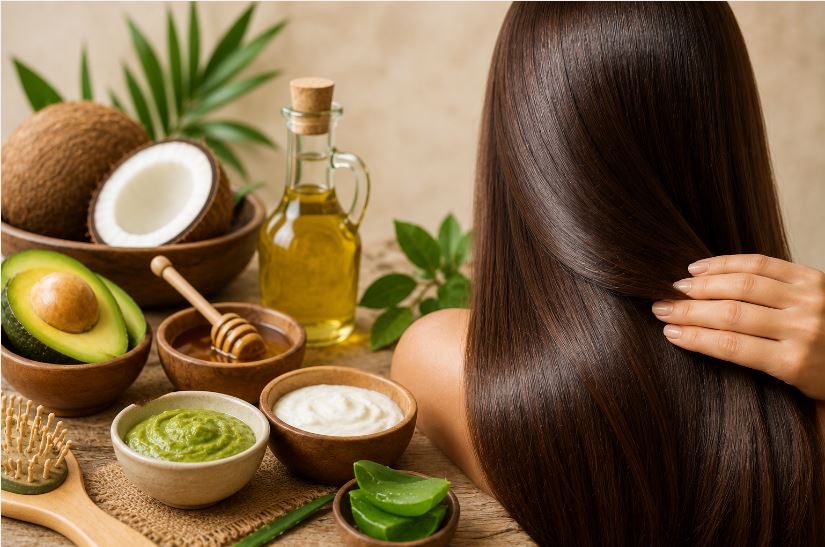
Keratin treatment gives you smooth, straight hair for weeks. It also involves heat, formaldehyde-releasing chemicals, and a salon bill you repeat every few months. If you are hunting for a natural alternative to keratin treatment, you are probably not against smooth hair. You are against what it costs your strands, your scalp, and your wallet to get there.
The good news: Ayurveda has been solving frizz and rough texture for centuries, long before smoothening serums existed. It just does it slower, and from the inside of the hair shaft rather than by coating it in chemicals.
This guide compares what keratin treatment does with what ayurvedic hair smoothening and almond oil hair care can realistically deliver, so you can decide if a chemical free hair treatment routine is the better fit for you.
Why People Look for a Natural Alternative to Keratin Treatment
Keratin treatment works by coating the hair shaft with a protein layer, then sealing it in with heat. That seal is what gives you the smooth finish. It is also where most of the concerns come from.
- Formaldehyde exposure: many keratin formulas release formaldehyde gas during the heating step, which is why some salons ventilate the room or ask you to leave during processing.
- Ongoing cost: touch-ups every 3 to 5 months add up quickly, especially with sulfate-free shampoo requirements on top.
- Hair that feels flat: the treatment weighs hair down, and natural volume and texture take months to fully return.
- Growing-out awkwardness: new growth at the roots looks noticeably different from the treated lengths.
None of this means keratin treatment is a bad option for everyone. It just means a lot of people want the smoothness without the trade-offs, and that is exactly where natural methods step in.
What Keratin Treatment Actually Does to Hair
Hair is largely made of a protein called keratin. Over time, heat styling, sun, and hard water strip away the outer protective layer, called the cuticle, and leave the shaft rough and porous. Rough cuticles catch light unevenly and tangle easily, which reads to us as frizz.
A salon keratin treatment temporarily patches this by gluing a synthetic protein layer over the damaged cuticle. It is effective, but it treats the symptom. The underlying hair is still the same hair underneath that layer. Ayurvedic approaches take a different route: they try to repair and strengthen the cuticle itself, so smoothness holds even without a coating.
This is the core difference worth understanding before you choose either path. A coating approach gives you a fast, dramatic result that eventually washes and grows out, taking you back to where you started. A nourishment approach works slower, but each session builds on the last, so the baseline condition of your hair actually improves over months rather than resetting every few weeks.
Ayurvedic Hair Smoothening: The Root-Level Approach
Frizz as a Nourishment Problem, Not Just a Texture Problem
Ayurveda treats frizz as a sign that hair is under-nourished and the scalp is out of balance, usually linked to a Vata imbalance, the dosha connected with dryness and roughness. Instead of sealing the shaft, ayurvedic hair smoothening focuses on feeding the hair with oils and herbs the strand can actually absorb.
Key Ingredients Behind Ayurvedic Smoothening
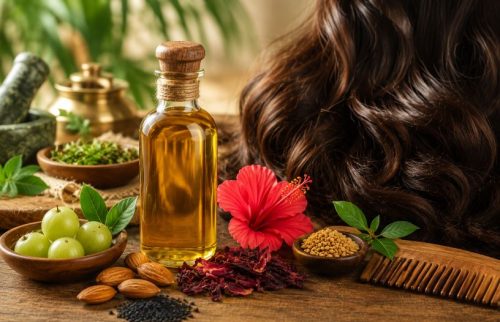
- Bhringraj: used for centuries to strengthen roots and add density, which makes hair less prone to frizz-causing breakage.
- Amla (Indian gooseberry): rich in vitamin C, it supports collagen-like protein production in the hair shaft.
- Hibiscus: acts as a natural conditioner, smoothing the cuticle and adding shine without silicone build-up.
- Fenugreek (methi): soaked and ground into a paste, it is a traditional deep-conditioning mask for rough, tangled hair.
These ingredients show up across most ayurvedic hair oil formulations, which is why regular oiling is considered the backbone of any natural smoothening routine, not an optional extra step.
Almond Oil Hair Care: The Everyday Smoothening Ritual
How Almond Oil Compares to a Keratin Serum
Almond oil will not glue your cuticle flat the way a keratin serum does. What it does instead is fill in the microscopic gaps in a damaged strand with fatty acids and vitamin E, so the surface reflects light more evenly and tangles less. This almond oil for hair breakdown covers exactly how that nourishment process works and what results to expect.
A Simple Almond Oil Routine for Smoother Hair
- Warm 2 to 3 tablespoons of virgin almond oil until just comfortable to touch.
- Section hair and massage the oil into the scalp for 5 to 8 minutes to boost circulation.
- Run the remaining oil through the mid-lengths and ends, where dryness and frizz usually start.
- Leave it on for at least an hour, or overnight for deeper conditioning, then wash out with a mild, sulfate-free shampoo.
- Repeat twice a week for the first month, then once a week for maintenance.
Ready to start your almond oil ritual?

Building a Complete Chemical-Free Hair Treatment Routine
Almond oil alone will smooth hair, but pairing it with a couple of supporting habits gets you closer to a salon-level finish without a single chemical step.
Weekly Ritual
- One almond oil scalp massage session, left on for a few hours before washing.
- One fenugreek or onion hair oil mask for strength, especially if hair fall is also a concern.
- One gentle detangling session using a wide-tooth comb on damp, oiled hair to reduce breakage.
Daily Habits That Support Smoothness
- A light hair serum applied to damp hair to seal in moisture before styling.
- Lower heat settings on styling tools, since high heat undoes a lot of what oiling repairs.
- Sleeping on a satin or silk pillowcase to reduce friction and overnight frizz.
Want the full toxin-free hair care lineup?

What Results to Expect (And What Not To)
This is the honest MOFU part of the comparison. A keratin treatment gives a dramatic, visible change within a single salon visit. A natural routine does not work that way.
- Expect gradual improvement in texture and shine over 4 to 6 weeks of consistent oiling, not overnight results.
- Expect less frizz and easier detangling, not poker-straight hair, since natural methods do not permanently alter hair structure.
- Expect the improvement to be cumulative. Hair usually keeps getting smoother the longer you stay consistent, unlike keratin, which fades on a fixed timeline.
If you need dead-straight hair for a single event, keratin will outperform any natural method. If you want manageable, healthier hair as a long-term habit, natural routines tend to win on cost and on how hair looks once you stop.
Complementary Natural Practices Beyond the Bottle
Ayurvedic hair care was never meant to be a single product. It sits inside a broader set of home rituals that Indian households have used for generations, and many of these are easy to adopt anywhere in the world.
Scalp massage and herbal masks made from ingredients like aloe vera and hibiscus are a well-documented part of this tradition. MorningSun’s guide to herbal hair masks for smoother, healthier hair is a useful companion read if you want mask recipes to rotate alongside your oiling routine.
Traditional remedies for scalp issues like dandruff, which often make frizz worse, are also part of this same root-cause approach. This guide to Ayurvedic remedies for dandruff and scalp care walks through home remedies that pair well with an oiling routine. And if you are curious where ingredients like ghee fit into Indian hair rituals historically, this piece on the role of ghee and Panchagavya in Ayurveda is worth a read.
Prefer guided mask recipes to pair with your oiling routine?

For NRIs and Frequent Travelers: Keeping Hair Smooth Across Climates
Hair behaves differently in humid Mumbai than it does in a dry winter in London or Toronto. Keratin treatment tends to fight humidity by force, sealing the shaft shut. A natural, oil-based routine adapts more easily. Richer oiling in dry, cold climates and lighter, more frequent oiling in humid ones lets you adjust week to week instead of committing to one fixed chemical process every few months. This flexibility is part of why so many NRIs return to oiling rituals after trying salon treatments abroad.
There is also a practical travel angle. Keratin treatment requires finding a trained salon technician wherever you are, and formulas vary a lot in quality outside India. A small bottle of almond oil, on the other hand, travels easily, needs no appointment, and works the same whether you are in Delhi, Dubai, or Chicago. For anyone splitting their year between countries, that consistency matters as much as the results themselves.
The Bottom Line
A natural alternative to keratin treatment will not give you the same one-visit transformation. What it gives you instead is smoother, stronger hair that keeps improving the longer you stick with it, without formaldehyde, without a recurring salon bill, and without an awkward grow-out line. For most people dealing with everyday frizz rather than chemically damaged hair, that trade is worth making.
Start your chemical-free smoothening routine today

FAQs:
Yes. Consistent oiling and ayurvedic herbs smooth hair gradually, without chemical coating.
Most people notice softer, less frizzy hair within 4 to 6 weeks.
No. It reduces frizz and improves texture, but does not alter hair structure permanently.
Yes. It is gentle and free of chemicals that strip hair color.
No. Many people alternate, using natural care between salon sessions.
External Resources
1. FDA — Hair Smoothing Products That Could Release Formaldehyde (U.S. Food and Drug Administration safety guidance)
2. NCCIH — Ayurvedic Medicine: In Depth (U.S. National Center for Complementary and Integrative Health)
3. NIH/PMC — Almond Oil: A Comprehensive Review of Its Composition and Benefits (peer-reviewed research overview)
Leave a Reply