
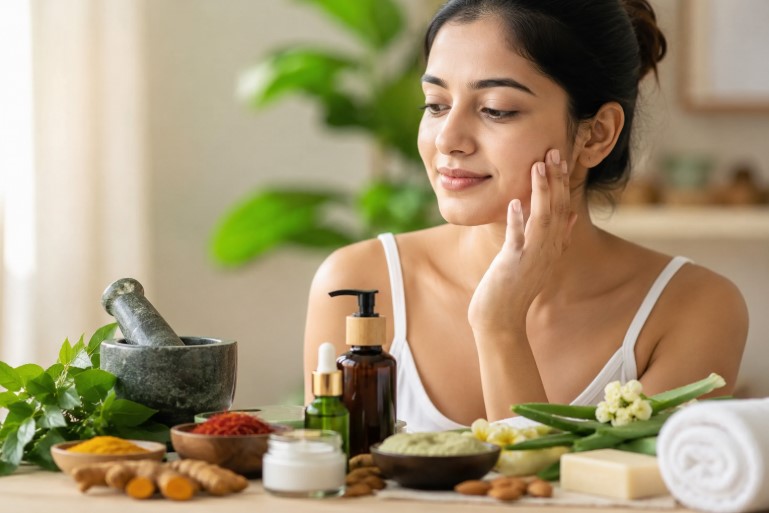
Your bathroom shelf might be doing more harm than good. Between imported serums, drugstore lotions, and gifted perfumes, most beauty cabinets quietly collect dozens of products nobody has properly checked. If you shop online from outside India, or you’re simply new to reading ingredient panels, telling genuine clean beauty apart from clever marketing gets confusing fast.
This checklist cuts through the guesswork. It is built for real routines — whether you are an NRI stocking up before a trip home, a new parent rethinking what touches your family’s skin, or someone tired of breakouts that never fully explain themselves. Treat it as the starting point for a genuinely chemical free beauty routine, not a one-time shopping list. By the end, you will have a simple, repeatable method for auditing every product you own and every product you buy next.
Why Your Beauty Cabinet Deserves a Toxin Audit
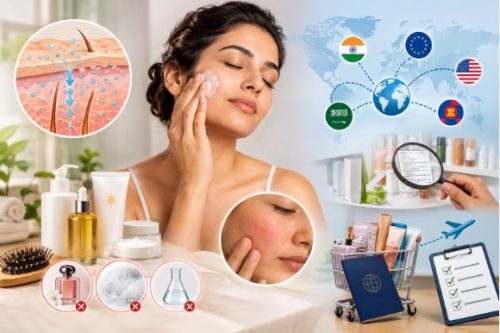
Skin is not a barrier that blocks everything you put on it. It absorbs a measurable share of whatever sits on the surface, especially with leave-on products used daily, such as moisturisers, hair oils, and sunscreens. Over months and years, small daily exposures to synthetic fragrance, harsh sulfates, and preservative overload add up, particularly for people with sensitive or reactive skin.
There is also a practical reason this matters more for a global audience. Cosmetic regulations differ sharply between India, the European Union, the United States, the Gulf, and Southeast Asia. A product legally sold in one country may contain an ingredient restricted in another. Relying on a single country’s approval is not enough — you need your own checklist that works no matter where you are shopping from.
What “Toxin-Free” Actually Means
Labels That Sound Clean but Say Very Little
Words like “natural,” “herbal,” and “Ayurvedic” are not strictly regulated terms in most markets. A product can call itself natural while still containing synthetic fragrance, sulfates, or mineral oil. Genuine toxin-free formulation is not a feeling on the label — it is a specific, checkable list of ingredients the brand has deliberately excluded, backed by a transparent ingredient panel you can actually read.
This is exactly why a checklist beats a slogan. A slogan asks you to trust the brand. A checklist asks you to verify it yourself.
Your Toxin-Free Beauty Products Checklist, Step by Step

1. Read the Ingredient List, Not the Front Label
Flip the bottle before you trust the packaging. The front label is marketing; the back panel is the actual formulation, usually listed in descending order of concentration. If the first five ingredients are water, a sulfate, a synthetic emulsifier, fragrance, and a preservative you don’t recognise, the “clean” claim on the front needs a second look.
2. Flag These Common Red-List Ingredients
Keep this short list in your phone notes when you shop, online or in-store:
- Parabens (methylparaben, propylparaben) — long-used preservatives linked to hormone-disruption concerns in repeated studies.
- SLS and SLES (sodium lauryl/laureth sulfate) — harsh foaming agents that strip natural oils and irritate sensitive skin.
- Synthetic “parfum” or “fragrance” — a single word that can legally hide dozens of undisclosed chemicals.
- Phthalates — often used to make fragrance last longer, linked to endocrine concerns.
- Formaldehyde-releasing preservatives (DMDM hydantoin, quaternium-15) — release small amounts of formaldehyde over time.
- Oxybenzone in sunscreens — a chemical UV filter under scrutiny for skin absorption and reef toxicity.
None of this means every product with one of these must be thrown out overnight. It means you now have a factual basis for choosing what to replace first.
3. Prioritise Formulation Over Fragrance
A strong scent is often the first thing people judge a product by, yet it is the least reliable signal of quality. Fragrance-heavy formulas frequently mask a weak or irritating base. Choose products that are lightly scented with essential oils or genuinely fragrance-free, especially for anything left on the skin overnight.
4. Look for Verifiable Claims, Not Just Certifications
Certifications help, but they are not the whole story. Ask whether the brand publishes its full ingredient list online, discloses sourcing, and shares batch or lab-test information on request. A brand willing to show its formulation in detail has far less to hide than one relying on a single “toxin-free” sticker.
5. Match Products to Your Skin Type and Climate

Clean does not automatically mean right for you. Someone moving between a humid Indian summer and a dry winter abroad needs a different balance of hydration and oil control than someone living in one climate year-round. Read the product’s intended skin type before adding it to your cabinet, not after a reaction shows up.
6. Keep the Cabinet Minimal and Multi-Use
A smaller number of trusted, multi-purpose clean beauty essentials is easier to audit than twenty half-used bottles. A gentle exfoliating scrub, a soothing gel, and a nourishing hair oil can cover most weekly needs — Advik Ayurveda’s Kesar Ubtan Face Scrub, for instance, is built as a twice-weekly exfoliant rather than a daily product, which keeps the routine simple and the skin barrier undisturbed.
A Category-by-Category Swap Guide

Once the checklist feels familiar, apply it category by category rather than replacing everything at once:
- Face wash / cleanser: swap sulfate-heavy foaming washes for a gentle, sulfate-free cleanser suited to your skin type.
- Exfoliant / scrub: choose a fine, natural-particle scrub, such as an ubtan-style formula, over plastic microbead scrubs.
- Gel / moisturiser: a paraben-free, lightweight aloe-based aloe vera gel works for most skin types across seasons and doubles as an after-sun soother.
- Hair oil: look for cold-pressed, additive-free oils, such as an onion-based hair oil, over mineral-oil-heavy “hair tonics.”
- Sunscreen: favour mineral filters (zinc oxide, titanium dioxide) over chemical filters if you have reactive skin.
- Deodorant: check for aluminium compounds and parabens, and patch-test alternatives before a full switch.
You can browse formulations built around this exact swap logic among natural skincare brands India trusts, where each product page lists what has been deliberately left out, not just what has been added.
Special Considerations If You Shop From Abroad or Visit India
NRIs and frequent travellers face a specific version of this problem: shelves in India carry brands and claims that are not verifiable through a familiar regulatory body back home. “Ayurvedic” is a strong marketing word, but not every product using it has been formulated with the same rigour. Before you stock up on a trip, or order online for a relative in India, it helps to understand how to separate genuine Ayurvedic formulation from a label that simply borrows the word.
If you want a clear, non-promotional breakdown of what actually makes a product or treatment Ayurvedic versus what is marketing language, DeshSansaar’s Ayurveda guidance for NRIs is a useful read before your next India trip or online order — it is written specifically for global Indians trying to make sense of claims from a distance.
When a Skin Reaction Needs a Dermatologist, Not Just a Swap

A checklist reduces risk; it does not replace professional care. If you notice persistent redness, cystic breakouts, or a reaction that does not settle within a week of switching products, that is a signal to stop self-treating and get it looked at properly, rather than trying a fourth or fifth swap on your own.
For NRIs and international patients planning a visit to India who also want a professional skin assessment alongside their wellness routine, Morning Sun’s personalised skin and hair programs in India connect you with verified cosmetic and dermatology specialists, so a clean beauty routine and a medical opinion can work together instead of guessing in isolation.
A Simple 30-Day Transition Plan
Trying to replace an entire cabinet in one weekend usually backfires. Spread it out instead:
- Week 1: audit your current products against the red-list ingredients above and set aside anything you’re unsure of.
- Week 2: replace your cleanser and moisturiser first, since these touch your skin daily and in the largest quantity.
- Week 3: switch your scrub, sunscreen, and hair oil, patch-testing each new product on your inner arm first.
- Week 4: review how your skin has responded, and keep only what genuinely worked in your permanent routine.

Conclusion
A toxin-free beauty cabinet isn’t built by buying everything labelled “natural” at once. It’s built one honest ingredient check at a time, one swap you actually stick with, and one routine simple enough that you can maintain it whether you’re in Delhi, Dubai, or Denver. Start with the checklist above, work through it category by category, and let your skin’s response — not the packaging — decide what stays.
Ready to start?
Build your cabinet around formulations that publish exactly what they leave out.
FAQs:
It means the formula deliberately excludes ingredients like parabens, sulfates, and synthetic fragrance.
No. “Natural” is unregulated; always check the actual ingredient list yourself.
Most open products last 6–12 months; discard sooner if texture or smell changes.
It’s safer to switch gradually, one category a week, while patch-testing each product.
Not automatically. Check the ingredient panel; the word “Ayurvedic” alone isn’t a guarantee.
Stop use immediately and consult a dermatologist if irritation lasts beyond a few days.
Leave a Reply