
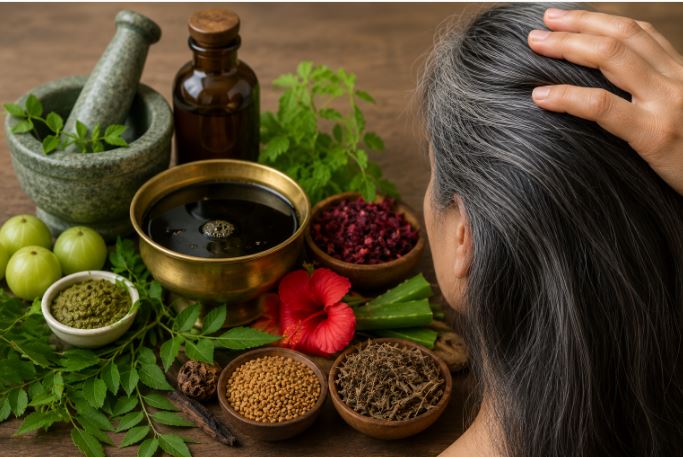
Finding your first grey hair in your twenties or thirties feels different from finding one at fifty. It raises a question most people don’t expect to ask so early: what is actually going on inside the body that shows up first on the scalp.
Ayurveda has always treated hair colour as a signal, not just a cosmetic issue. Ayurvedic remedies for premature greying are built on this idea: that grey strands often point to something happening in digestion, stress levels, or nutrient absorption, not just genetics or age. Understanding that connection changes how you approach treatment, and what you can realistically expect from it.
Why Ayurveda Sees Premature Greying Differently
Modern hair care usually treats grey hair as a surface problem, something to colour over or slow down with topical products. Ayurveda takes a different starting point. Hair, in Ayurvedic thinking, is considered a by-product of bone tissue and is nourished through the same nutritional pathway as bones and blood. If that pathway is disrupted by poor digestion, excess heat in the body, or chronic stress, hair pigment is often one of the first things affected.
This is why Ayurvedic treatment rarely stops at oiling the scalp. A complete approach looks at digestion, stress, and diet alongside topical care, because pigment production is treated as connected to internal balance, not just what touches the hair.

Ready to make amla and bhringraj part of your everyday hair routine? Try Amla Bhringraj Shampoo Now →
The Real Causes Ayurveda Looks At
Pitta Imbalance and Excess Heat
In Ayurveda, hair pigment is closely linked to Pitta, the dosha associated with heat and transformation. When Pitta is aggravated, whether from spicy food, excess sun exposure, or emotional stress, it is believed to affect the pigment-producing processes in the hair follicle. This is one reason Ayurvedic protocols for greying often focus as much on cooling the body as on nourishing the scalp.

Weak Digestion and Poor Nutrient Absorption
Ayurveda places heavy emphasis on agni, or digestive fire. If digestion is weak, nutrients from even a healthy diet may not reach the hair follicle efficiently. This is often overlooked in conversations about grey hair, which tend to focus entirely on topical oils rather than whether the body is actually absorbing what it needs.
Stress and the Melanin Connection
Chronic stress raises cortisol, which several studies have linked to reduced melanin production over time. Ayurveda arrived at a similar conclusion long before modern research, treating unmanaged stress as one of the more significant, and most correctable, contributors to early greying.
Genetics, Acknowledged Honestly
Ayurveda does not claim to reverse greying that is primarily genetic. Family history plays a real role, and no herbal remedy changes that baseline. What Ayurvedic care aims to do is slow the progression and support the hair that has not yet greyed, rather than promise a full reversal that genetics may not allow.
Amla for Grey Hair: The Science Ayurveda Got Right Early
Indian gooseberry, is one of the most consistently recommended ingredients in Ayurvedic hair care, and it holds up well under modern scrutiny too. Amla for grey hair works through its extremely high vitamin C and antioxidant content, both of which support the health of hair follicles and help protect existing pigment-producing cells from oxidative stress.
Amla is used in multiple forms: as fresh juice taken internally, as an oil infusion applied to the scalp, and as a powder mixed into hair masks. Internal use is often underrated. Many Ayurvedic practitioners consider a spoon of amla juice or powder taken daily to be as important as any topical application, since it supports the digestive and nutrient pathway that eventually reaches the hair follicle.
Bhringraj Hair Oil Benefits: More Than Just Colour
Bhringraj is often called the “king of herbs” in Ayurvedic hair care, and its role goes beyond pigment support. Benefits of bhringraj hair oil include calming an overactive scalp, supporting circulation, and reducing the kind of chronic scalp inflammation that can accelerate both hair fall and greying.
Because Bhringraj is also traditionally used to calm the nervous system, it addresses two of the root causes at once: the direct nourishment of the hair follicle, and the stress-related pathway that contributes to early greying in the first place. This dual action is part of why Bhringraj appears in nearly every serious Ayurvedic protocol for hair growth, not just as a folk remedy but as a genuinely multi-purpose ingredient.
Building a Complete Protocol, Not Just a Remedy
A single oil or one herbal ingredient rarely addresses premature greying on its own. Ayurveda approaches it as a layered protocol:
- Internal support through amla, Brahmi, and a Pitta-pacifying diet that reduces excess heat in the body.
- Topical nourishment through regular scalp oiling with Bhringraj and amla-based oils, ideally two to three times a week.
- Stress management through consistent sleep, breathing practices, and reducing chronic overstimulation.
- Gentle, sulfate-free cleansing that does not strip the scalp of the natural oils these herbs are meant to support.
If you want the detailed oiling routine and mask preparation steps, our in-depth guide on ayurvedic remedies for hair greying naturally walks through each step individually. This piece focuses more on why these remedies work and how to combine them into something sustainable.
Natural Hair Color Remedies vs Chemical Dyes: What to Expect
Many people search for natural hair color remedies hoping for an instant, dye-like result. It helps to set expectations early: herbal remedies work by supporting the hair’s own pigment-producing processes, not by depositing colour the way a dye does. This means results are gradual, and they work best on hair that has only recently started greying, rather than hair that has been fully white for years.
Some traditional remedies, like henna mixed with indigo, do deposit a visible tint and can darken hair more immediately, though this is a colouring effect rather than a pigment-restoring one. True Ayurvedic remedies for greying, based on amla, Bhringraj, and internal balance, work on a slower timeline but aim at the underlying cause rather than masking the result.

Want an easier way to bring amla and bhringraj into your routine every wash? Try Bhringraj Hair Oil →
Pitta-Pacifying Foods That Support Hair Pigment
Since Ayurveda links excess Pitta to pigment disruption, diet plays a bigger role in premature greying than most hair care routines acknowledge.
- Cooling foods like cucumber, coconut water, and pomegranate help balance excess internal heat.
- Fresh amla, eaten whole or as juice, is one of the most direct dietary additions for hair pigment support.
- Leafy greens and sesame seeds provide iron and calcium, both linked to healthy hair growth cycles.
- Reducing excess caffeine, fried food, and very spicy meals helps limit the kind of internal heat Ayurveda associates with aggravated Pitta.
- Staying well hydrated supports both digestion and the nutrient delivery pathway that eventually reaches the scalp.
None of these changes work overnight, but they support the internal half of the protocol that topical oils alone cannot address.
Common Mistakes That Slow Down Results
Only using one remedy. Applying Bhringraj oil alone, without addressing diet or stress, tends to produce slower, less noticeable results than a combined approach.
Expecting existing grey strands to darken. Most remedies support pigment in new growth. Existing grey hair rarely reverses fully, and expecting it to often leads people to abandon a routine that is actually working on new growth.
Switching products too frequently. Rotating between different oils and shampoos every few weeks does not give any single formulation enough time to show a measurable effect.
Ignoring stress and sleep. Topical care without addressing chronic stress addresses only half of what Ayurveda considers the root cause.

Why a Ready-Made Formula Often Works Better Than DIY
Preparing fresh amla and Bhringraj oil infusions or hair packs at home is effective, but it is time-consuming and easy to abandon after a few weeks, right around the point when consistency starts to matter most. This is where a well-formulated, ready-made option becomes genuinely useful rather than just convenient.
A shampoo built around Amla and Bhringraj in the right concentration allows you to bring these ingredients into your routine every wash, without the prep time of boiling oils or grinding herbs into a paste. It will not replace a deeper weekly oil massage, but it keeps the internal-external protocol going on the days a full routine is not realistic.
Setting Realistic Timelines
Ayurvedic remedies for premature greying are not a quick fix, and any product promising visible reversal in days is worth questioning. Most people following a consistent internal and topical routine report noticing a difference in new hair growth, rather than existing grey strands, after around three to four months. This is because pigment support works at the follicle level, affecting hair as it grows in, not hair that has already emerged without pigment.
Consistency matters more than intensity here. A moderate routine followed for months tends to outperform an intense routine abandoned after a few weeks.
When to Look Beyond Home Remedies
If greying is sudden, patchy, or accompanied by other symptoms like unexplained fatigue or hair thinning, it is worth ruling out underlying causes such as thyroid issues or vitamin B12 deficiency with a doctor before assuming it is purely age or stress related. Ayurvedic remedies work well alongside medical care, but they are not a substitute for diagnosis when the pattern looks unusual.
For those who want a more structured, guided approach to addressing root causes like stress and digestion rather than piecing together a routine alone, working with a qualified Ayurvedic practitioner can help build a plan suited to your specific constitution rather than a generic one. It also helps to understand what genuine, evidence-aware Ayurvedic care looks like before committing to any practitioner or programme, which our sister site DeshSansaar’s guide to evaluating Ayurveda treatment covers in more detail.

Want the full breakdown of causes, treatments, and products for grey hair? Explore More Ayurvedic Hair Care Guides →
Conclusion
Ayurvedic remedies for premature greying work best when they are treated as a routine, not a rescue attempt. Amla and Bhringraj address both the internal and topical sides of the problem, but the results depend on consistency, realistic timelines, and addressing root causes like stress and digestion alongside the hair itself. Start where you can sustain it, and let the rest build from there.
FAQs:
It can slow progression and support pigment in new growth, but full reversal is not guaranteed.
Most people notice changes in new hair growth after three to four months of consistent use.
Both matter; internal use supports digestion while topical use nourishes the scalp directly.
Yes, chronic stress is linked to reduced melanin production over time in several studies.
Yes, most gentle, sulfate-free formulations are suitable for regular use.
Leave a Reply