
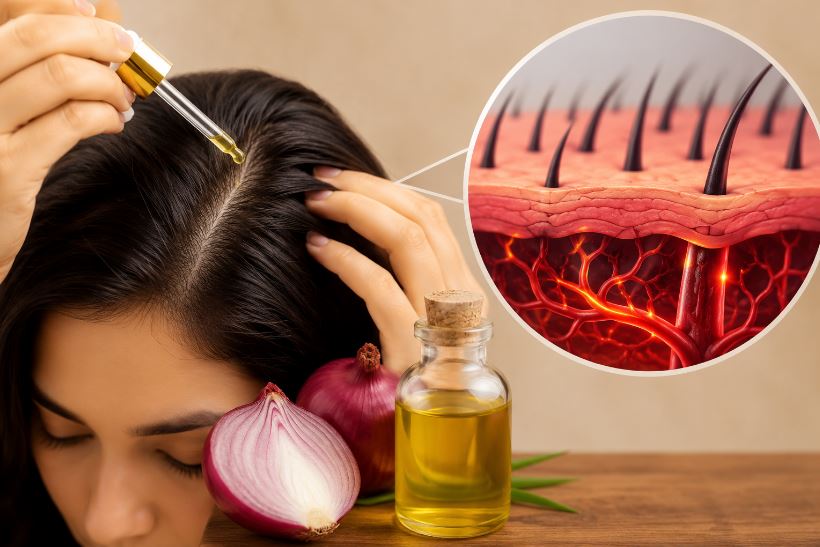
Hair fall is one of the most common hair-care concerns, but does onion oil actually help? This guide explains what onion oil may do for your scalp and hair, what research says, how to use it, and what to look for when choosing an onion hair oil.

In this guide, you’ll learn:
- How onion oil may support hair health
- What research actually shows
- How to use onion oil correctly
- How to choose an onion hair oil
- When hair fall may need professional evaluation
If you’ve tried anti-hair-fall shampoos, avoided excessive heat, and started paying closer attention to the hair left on your pillow or comb, you’re definitely not alone. At some point, searching “why is my hair falling?” turns into looking for remedies that might actually help — and that’s usually when onion oil enters the conversation. But there’s more to onion oil than simply knowing it is popular for hair fall. You need to understand why it might help, what kind of results are realistic, and how to choose a genuine product instead of a heavily diluted one. In this guide, we’ll break down onion oil for hair fall in straightforward language and look at what dermatology research has to say, so you can decide whether it makes sense for your hair-care routine — no matter where you’re buying it, from Mumbai to Manchester or Michigan.
Why Onion Oil Works for Hair Fall
Onions belong to the allium family, and they carry an unusually high concentration of sulfur compounds. Sulfur isn’t just the smell you get used to after a few applications — it’s a building block your body needs to make keratin, the protein that makes up almost all of a hair strand. When hair lacks enough sulfur-rich amino acids, strands tend to grow thinner, weaker, and more prone to snapping. That’s the basic logic behind onion oil for hair fall: feed the follicle what it needs to build stronger keratin, and you reduce breakage at the source rather than just masking the symptom with a heavier conditioner.
Sulfur, Keratin, and Hair Structure
Each strand of hair is roughly 90% keratin, a fibrous protein held together by sulfur bonds called disulfide bonds. These bonds give hair its strength and elasticity. Onion extract is rich in organosulfur compounds, and when massaged into the scalp, it’s believed to support the local supply of sulfur available to hair follicles. This doesn’t rebuild hair overnight, but it does explain why regular users typically report less breakage and fewer split ends within a few weeks, rather than dramatic overnight regrowth.
What the Research Actually Shows
The most cited clinical study on onion and hair growth comes from a 2002 trial published in the Journal of Dermatology. Researchers applied crude onion juice to patchy bald spots caused by alopecia areata, an autoimmune condition, and compared results against a group using plain tap water. Within six weeks, close to 87% of the onion juice group showed visible regrowth, compared to just 13% in the control group (Sharquie & Al-Obaidi, 2002). It’s worth being honest about what this study does and doesn’t prove: it looked at autoimmune patchy baldness, not everyday thinning from stress, pollution, or scalp neglect. But it does confirm onion has a real, measurable effect on hair follicles — not just folklore passed down from grandmothers.

If you’d rather skip the mess of making onion juice at home, Order Onion Hair Oil Now and get the same active compounds in a stable, ready-to-use Advik Ayurveda formula.
Onion Oil Hair Growth: What to Expect, Week by Week
Onion oil hair growth isn’t a switch that flips overnight, and any product promising instant results should be treated with suspicion. In the first one to two weeks, most people notice less hair on their pillow and hairbrush, since the oil calms an irritated scalp and reduces breakage before it reaches the strand. Between weeks three and six, scalp circulation typically improves, which is when short new hairs start showing up along the hairline if you look closely under good light. By weeks eight to twelve, with consistent twice-weekly use, strands generally look thicker at the roots and less prone to snapping mid-length. Results vary based on the underlying cause of your hair fall — nutritional gaps, hormonal shifts, and post-illness shedding all respond at different speeds, so patience and consistency matter more than which specific brand you pick.
How to Choose the Best Onion Oil in India
Walk into any pharmacy or scroll through an e-commerce app and you’ll find dozens of onion hair oils, all making near-identical claims. Since India’s cosmetic labeling rules don’t force brands to disclose exact onion concentration, picking the best onion oil in India comes down to reading the ingredient list carefully rather than trusting the marketing copy on the front of the bottle.
Ingredients That Matter
Look for a formula built on a genuine onion extract or onion seed oil base, not just a fragrance layered onto mineral oil. Cold-pressed carrier oils like coconut or sesame help the active compounds absorb into the scalp instead of sitting on top of the hair shaft. Supporting ingredients such as black seed oil, curry leaves, or bhringraj add antioxidant and anti-inflammatory support, which matters if your hair fall is tied to scalp irritation or dandruff. Be wary of oils where onion appears near the very end of the ingredient list — that usually signals it’s present in trace amounts only, added for the label rather than for effect.
Red Flags to Avoid
Be cautious of any product promising visible regrowth in under two weeks — no topical formula works that fast, and claims like this are usually a sign of exaggerated marketing rather than a stronger formula. Also skip oils built primarily on mineral oil, with artificial fragrance high on the ingredient list, or with no batch number or expiry date printed on the packaging. A genuine onion hair oil should smell mildly of onion, not be masked entirely by perfume; a heavy masking scent often means very little actual onion extract made it into the bottle.
Advik Ayurveda’s onion hair oil skips these shortcuts — it’s built on cold-pressed onion extract, coconut oil, and hair-strengthening herbs, with nothing to hide behind a heavy fragrance. Order Onion Hair Oil Now and try a formula built around ingredients, not marketing claims.
Onion Hair Oil Benefits Beyond Hair Fall

While reducing hair fall is one of the main reasons people use onion hair oil, its potential benefits may go beyond controlling excessive shedding. Regularly massaging onion oil into the scalp can help improve blood circulation, which may support the delivery of nutrients to hair follicles. Onion extract also contains antibacterial and antifungal properties that may help manage mild dandruff and scalp itching, especially when used alongside a gentle, sulphate-free shampoo. With consistent use, some people may also notice that their hair feels softer and looks shinier because the oil helps condition the scalp and hair. Onion oil contains antioxidants as well, which may provide some support against oxidative stress, a factor associated with premature greying. However, this benefit is less noticeable and may take longer to appear than changes in hair shedding. If you want to compare different Ayurvedic oils for hair growth and thickness, this guide can provide additional information.
Is Onion Oil Worth It for NRIs and Hair Care Abroad?
If you’ve moved abroad, you may have noticed your hair behaves differently than it did back home. Harder water in parts of the US and UK, dry winter heating, and colder climates can all increase breakage and scalp dryness. Onion oil travels well and doesn’t need refrigeration, which makes it a practical addition to a hair-care routine even outside India. Many NRIs also switch to it after finding that local anti-hair-fall products address the strand but ignore scalp health, which is where an Ayurvedic oil tends to fill the gap. When buying from abroad, check that the seller ships internationally and that the bottle is sealed and batch-coded, since counterfeit and heavily diluted onion oils circulate on unofficial marketplaces. Ordering directly from a verified Indian brand’s own website is usually the safer route if you want a formula that matches what’s actually printed on the label.
How to Use Onion Oil the Right Way

A Simple Application Routine
Start with a patch test on your inner arm 24 hours before your first scalp application, since onion extract can occasionally irritate sensitive skin. Once cleared, section your hair and massage the oil into your scalp using your fingertips, not nails, for about five to ten minutes to encourage circulation. Leave it on for at least an hour, or overnight if your scalp tolerates it well, then wash it out with a mild, sulphate-free shampoo. Twice a week is a reasonable starting frequency for most people; daily use isn’t necessary and can leave the scalp feeling greasy without adding extra benefit.
Common Mistakes That Waste a Good Bottle
The biggest mistake is inconsistency — using the oil for ten days, seeing no dramatic change, and giving up before the six-to-eight-week mark where results typically begin to show. Another common error is applying oil to already-dirty, product-heavy hair, which blocks absorption at the scalp. Skipping the patch test is also risky, since onion extract is potent and a small percentage of users do react to it. Finally, storing the oil in direct sunlight or near heat can degrade the active compounds faster, so a cool, dark cabinet works better than a bathroom windowsill.
Consistency is a lot easier when the product itself is worth sticking with. Order Onion Hair Oil Now and build a twice-weekly routine around a formula made for exactly this.
When Home Remedies Aren’t Enough
Onion oil works well for hair fall linked to scalp health, breakage, and mild thinning. But hair loss tied to hormonal shifts, thyroid changes, PCOS, or a strong genetic pattern often needs more than topical care alone. According to the American Academy of Dermatology, identifying the underlying cause is the key step in treating hair loss effectively, since different causes respond to different treatments. If you’ve been consistent with onion oil for over three months without improvement, or you’re noticing a widening parting, a receding hairline, or bald patches, it’s worth getting a proper scalp and hormone evaluation rather than switching oils again. For readers living abroad or planning a trip to India, Morning Sun connects patients with verified Ayurvedic hair fall and scalp detox programs, alongside dermatology and hair transplant specialists, so you can get a professional opinion to sit alongside your home care routine rather than instead of it.
Pairing Onion Oil With a Broader Ayurvedic Lifestyle

Hair health in Ayurveda is never treated as an isolated problem — it’s tied to digestion, stress, and daily routine as much as to what you apply on your scalp. If dandruff or an itchy scalp is part of your hair fall story, DeshSansaar has a practical breakdown of Ayurvedic remedies for dandruff that pairs well with an onion oil routine. For NRIs and first-generation Indian families abroad trying to reconnect with these traditions, DeshSansaar’s wider library on Ayurveda and everyday Indian wellness is a useful starting point beyond hair care alone. You can also read more Ayurvedic approaches to hair fall on Advik Ayurveda’s natural remedies guide. Combining a targeted product like onion oil with these broader lifestyle habits — diet, stress management, and gentle hair handling — tends to produce more lasting results than any single remedy used alone.
Conclusion
Onion oil for hair fall isn’t a miracle cure, but it is one of the few home remedies with real clinical backing behind the biology. Used consistently, alongside a gentle hair-care routine and a bit of patience, it can meaningfully reduce breakage and support healthier growth over two to three months. If your hair fall doesn’t improve with home care, don’t hesitate to get a professional opinion — sometimes the scalp needs more support than any oil, however good, can offer on its own.
Ready to give your scalp what it actually needs? Order Onion Hair Oil Now and start your first onion oil routine this week.
FAQs:
Yes, its sulfur content supports keratin and reduces breakage with consistent use.
Less shedding in 2–3 weeks; visible growth usually takes 8–12 weeks.
Twice weekly is enough; daily use can make the scalp greasy without added benefit.
A mild onion scent is normal at first; it fades within an hour of washing.
Generally yes, but patch-test first and check with your doctor if unsure.
Pick a cold-pressed formula with onion extract listed high on ingredients.
External Resources
1. Sharquie, K.E. & Al-Obaidi, H.K. (2002). Onion juice (Allium cepa L.), a new topical treatment for alopecia areata. Journal of Dermatology — PubMed
2. American Academy of Dermatology — Causes of Hair Loss
Leave a Reply